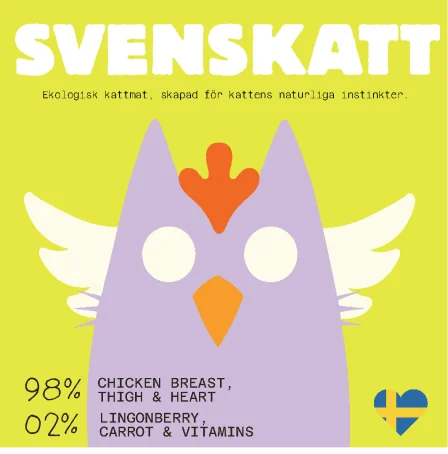
The front of a cat food bag and the back of a cat food bag are written by different teams with different goals. The front team wants you to buy it. The back team wants to stay inside the law.
Once you know what the law actually says, the back tells you almost everything you need.
Rule 1: the naming game
Pet food regulators have rules about how much of a named ingredient has to be in a product before the name can use it. The exact percentages differ between the US AAFCO framework and EU Regulation 767/2009, but the principle is the same.
In the EU framework, the rules of thumb are these:
| What the label says | What it means |
|---|---|
| ”Chicken cat food” or “100% chicken” | The named ingredient is the only animal protein source. |
| ”Rich in chicken” | The named ingredient is at least 14% of the recipe. |
| ”With chicken” | The named ingredient is at least 4% of the recipe. |
| ”Chicken flavour” | Less than 4%. Just enough to taste. |
In the US, AAFCO uses similar tiers (95% / 25% / 3% / “flavour”). Either way, “with chicken” tells you something close to nothing about the actual chicken content.
The trick most owners miss: “Beef and chicken cat food” can hide a recipe that’s mostly something else, as long as beef and chicken together hit the threshold. The named species are not necessarily the largest ingredient.
Rule 2: ingredient order means weight, not nutrition
Ingredients are listed by weight, in descending order. That sounds objective, and it is, but weight is measured before processing.
“Fresh chicken” listed first can mean a chicken that was 70% water at weigh-in. By the time the kibble is dried, the chicken contributes less to the finished product than the “rice flour” listed third, which arrived bone-dry. The label is technically correct and practically misleading.
The other trick is ingredient splitting. If you list “wheat, wheat gluten, wheat bran” separately, none of them individually outweighs the first ingredient. Combine them, and wheat is bigger than anything else in the bag. Same trick works with “peas, pea protein, pea fibre”.
The fix is simple: read the ingredient list to the comma about ten in. If you see the same crop, fish, or legume listed three different ways in those ten ingredients, the label has been engineered.
Rule 3: the catch-all terms
Some terms exist because they let manufacturers swap ingredients between batches without changing the label.
- “Meat and animal derivatives” is an EU collective term. It can include any species (chicken, beef, pork, lamb), any tissue (muscle, bone, viscera, blood), and the mix can change without notice. The species isn’t named because it isn’t fixed.
- “Animal derivatives” is narrower but still vague. You don’t know which animal.
- “Cereals” is the same trick on the plant side. Wheat one month, maize the next.
- “Meat meal” is a rendered, dried protein concentrate. Water removed, fat removed, ground. Quality varies enormously depending on what was rendered. A “chicken meal” with a named species is informative. A “meat meal” with no species named is not.
A cleanly labelled food names every animal and grain by species or cultivar. Our recipes list “chicken muscle (Sweden, 62%)” and “beef heart (Sweden, 8%)” rather than “meat and animal derivatives”. The numbers are there because we measured them.
Rule 4: analytical constituents, on a dry-matter basis
The “analytical constituents” panel reports crude protein, fat, fibre, ash, and moisture as percentages. To compare a wet food (75% moisture) with a dry food (8% moisture), convert to dry matter first.
The maths: divide the listed nutrient percentage by (100 minus moisture), then multiply by 100.
A wet food listing “10% protein, 75% moisture” has 10 ÷ (100 − 75) × 100 = 40% protein on a dry-matter basis. A kibble listing “30% protein, 8% moisture” has 30 ÷ 92 × 100 = about 33% on a dry-matter basis. The wet food, lower on the front of the can, contains more protein per gram of actual food than the kibble.
Most owners look at the front number and pick the higher one. The maths usually reverses the order.
Five red flags worth knowing
- Unnamed species. “Meat”, “fish”, or “poultry” with no specific animal.
- Same ingredient split. Three different wheat forms in the top ten.
- “With” on a front-of-pack claim. Less than 4% in the EU, less than 3% in the US.
- No AAFCO or FEDIAF complete-and-balanced statement for the cat’s life stage.
- A taurine claim but no muscle meat near the top. Synthetic taurine bolted onto a low-quality base is a red flag, not a feature.
What a clean label looks like
You should be able to read every ingredient on the bag and know what it is, where it came from, and roughly how much of it the recipe contains. If the bag dodges any of those three, the bag is hiding something.
Our complete-and-balanced statements run against FEDIAF guidelines for adult cats, with batch-level taurine analysis on every cook. If you want to see how the recipes themselves look from the inside, the fresh-vs-kibble piece covers the manufacturing differences, and the nutrition guide explains why every line on the label matters more for cats than it does for any other pet.
Reading a label well takes about thirty seconds once you know what to look for. Doing it on the next bag you buy is the cheapest thing you’ll ever do for your cat.