“Made in Sweden” looks like a sticker. What sits behind it is a body of law that runs stricter than the EU baseline on almost every measure that matters to an animal. Here is what’s actually in the law, why it ends up in your cat’s bowl, and the trade-off we accept to keep it that way.
What Swedish law requires that EU minimums don’t
Sweden joined the EU in 1995 with an animal welfare framework that was already stricter than what most other member states had. Successive governments have kept it that way. The current rules come from the Animal Welfare Act of 2018 and the supplementary regulations issued by Jordbruksverket, the Swedish Board of Agriculture.
The differences that matter most:
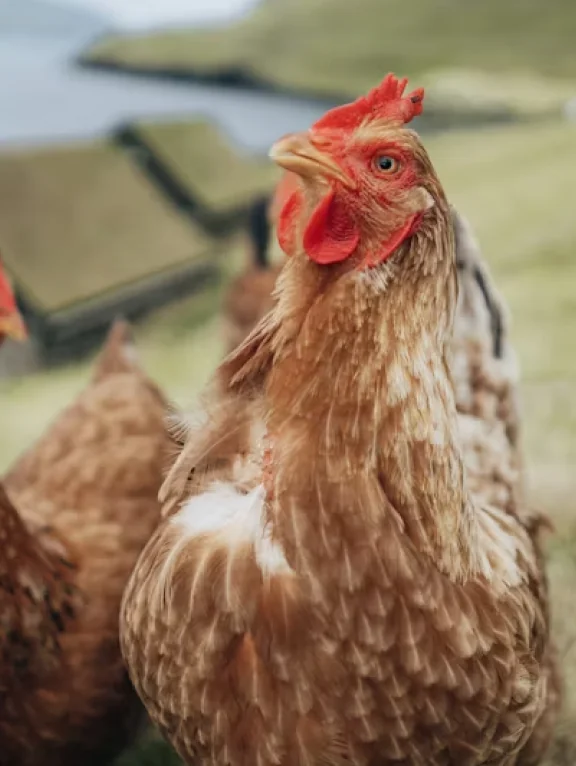
Poultry
- Maximum stocking density of 20 kg per square metre for broiler chickens on standard farms, rising to 36 kg/m² only for farms enrolled in the welfare programme with stricter monitoring. The EU baseline allows 33 kg/m² as standard and up to 42 with derogations.
- No beak trimming. This is a routine procedure in many EU countries to manage feather-pecking in crowded flocks. It’s banned in Sweden, which means flocks have to be small enough and enriched enough that pecking isn’t a problem in the first place.
- Mandatory access to natural daylight in chicken housing.
Pigs
- Sows kept loose during the entire mating cycle. Gestation crates, which keep sows confined for most of pregnancy, are illegal in Sweden. The EU is phasing them out for the first four weeks of gestation only.
- Tail docking is prohibited as a routine procedure. Like beak trimming, this is normally done to manage stress behaviours that emerge in overcrowded conditions, so the ban forces lower density and better enrichment.
Slaughter
- Mandatory stunning before slaughter with no religious exemptions. Many EU countries allow derogations for halal and kosher slaughter without prior stunning. Sweden does not.
- A vet must be present during slaughter.
Antibiotics
- Antibiotics for growth promotion were banned in Sweden in 1986, almost twenty years before the EU-wide ban in 2006. Therapeutic antibiotic use is also significantly lower than the EU average. Sweden has had the lowest use of antibiotics in livestock in Europe for over a decade, by a wide margin.
Why this ends up in your cat’s bowl
Some of these standards matter for the cat directly. Others matter because of what they say about the system the meat came from.
Lower antibiotic load is the most concrete one. Antibiotic resistance is a real, slow-moving public health problem, and the WHO has been clear since 2017 that livestock antibiotic use is one of its drivers. Buying meat from low-use systems puts less pressure on resistance and means fewer antibiotic residues in the supply chain.
Lower-stress animals make better food. Cortisol levels in muscle at slaughter affect meat quality in measurable ways: water-holding capacity, pH, keeping properties, and protein integrity. The differences aren’t enormous, but they’re real and they compound when you cook gently rather than render hot.
Traceability is the bigger one. Sweden has a small enough livestock sector that we can name every supplier we work with and visit them in a day’s drive. We do. Most large-scale pet food brands buy commodity rendered meals through international wholesalers; the species and farm of origin are functionally unknowable. Buying domestic isn’t about flag-waving. It’s about being able to walk back up the supply chain when something needs checking.
The trade-off we accept
Swedish-raised meat costs more. A common estimate is around 30% above the EU average for chicken, and about 15 to 20% above average for pork and beef. Some of that is genuine welfare cost (lower density means more space per bird, which means more buildings and more labour per kilo of finished meat). Some of it is the cost of small-scale slaughter and short supply chains. Some is just Swedish wages.
We pay the difference. So does the price on the box. We’ve never claimed to be the cheapest fresh cat food in the country, and the sourcing decision is most of the reason.
The alternative would be to buy commodity meat at EU average prices and put a Swedish-flag sticker on the box. Plenty of pet food brands on Swedish shelves do exactly this. Most “premium” cat food sold in Sweden is manufactured in Germany, France, or the Netherlands using non-Swedish meat.
Where our four proteins come from
| Recipe | Origin |
|---|---|
| Chicken | Skåne and Halland, free-range farms enrolled in the Svensk Fågel welfare programme |
| Beef | Småland, with KRAV-certified herds where available |
| Pork | Östergötland, from farms in the LRF welfare network |
| Fish (cod and salmon) | MSC-certified Baltic and North Atlantic |
We list these on every product page and we update the list when suppliers change. If a recipe ever runs out of Swedish-sourced primary protein, we pause that recipe rather than substitute.
What we can’t claim
A few things we are careful not to overstate:
- Swedish meat is not nutritionally different from non-Swedish meat in any meaningful way. The amino acid profile of chicken muscle is the same whether the chicken grew up in Skåne or in Brittany. The differences we care about are welfare, antibiotics, and traceability.
- “Local” is relative. Skåne is 600 km from Gävle. We ship long distances within Sweden because that’s where the farms are.
- Wild fish is more complicated than farmed welfare. MSC certification is the strongest signal we have, but it’s not perfect.
The honest version of our sourcing story is that we buy from a small country with stricter rules than most, we visit the farms we buy from, and we pay 20 to 30% more than we would if we bought commodity. If you’d like to see how that meat actually ends up cooked, the fresh-vs-kibble piece covers the kitchen side. If you want to see the recipes, they’re over here.
The bowl in front of your cat is the last step in a chain that’s a few hundred kilometres long. We try to know every link in it.